One Hour Photo
Robin Williams
In this section:
In this section the Point of view, the camera techniques, acting, sound, setting and characters. The film is discussed in more detail and given in more depth. You will be able to read up to 6 elements of the media process and uncover more then you might’ve thought originally.
Point Of View –
In the film text, One Hour Photo the narrative is presented from ‘Sy’, Robin Williams’s character. The audience became aware of tis in the opening sequence when they are introduced to his character using a close up and narration. This is shortly followed by an inner-monologue by Robin Williams foreshadowing the final events within the narrative. Although Sy is the antagonist in this psychological thriller the audience learn to empathise with his character considering the amount of story-Information provided to them by Director Romenbek.

Camera – Techniques & qualities including shot selectin, movement & focus
The way the camera moves, pans, the angle and the framing helps tell the story. It can provide an insight to the characters and their lives, place importance on or emphasises certain objects, events and actions, help set the mood of a scene and/or provide a point of view.
Angle: In the film, One Hour Photo, there are multiple angles hat help create the mood of somewhat suspicion and fear in the film. Being a drama/thriller, it helps that in certain areas that that had a few angles of Sy Parrish (Robin Williams’s character) that gives the viewer a feeling of weakness and started making the viewer ask a few questions. There are angles that show how Sy’s life is filled with loneliness and as you come to the realization, Sy has grown attached to family that he develops photos for and he collects his own set as the time goes on. There are multiple times that the angles that have been shot show the environment that perceive Sy as a “normal” character until he is seem in his living room watching TV. There were sometimes that Sy had been taken at a low camera angle to make him seem more powerful and to emphasise his height. But also there was few high camera angles that showed him being weak and struggling.
In this film, the audience is also given Sy’s point of view which helps the viewer see what Sy would be seeing and how he might be feeling. This is very effective in enhancing the audience’s identification with Sy’s experiences.
Movement: the camera movement is a way the audience gets a lot of their information. There are a few times in the film there are circumstances that involve the camera panning from left to right, this can be seen in the scene that involves Sy leaving SavMart late and the angle is a low camera angle, this was a slow pan that panned as soon as Sy walked past the camera, following his footsteps. The fact it was a slow pace pan gave a dramatic effect possibly making the viewer question what was the character doing or where was he going to make the camera pan this way.
Distance/Placement: The distance of the camera in the scene indicates to the audience how involved they will become with the characters or setting. There are some scenes where the character, Sy, is shown looking from a distance at an object or person in this case. He is seen walking from a distance until finally reaching his car, looking from his car out to the Yorkin’s family home but also in this scene he ends up day dreaming to then being caught inside until then flashing back to his car where he is spying on the house and then driving away in a hurry with the realization of actually being caught for real. Sy is also seen trailing the Yorkin’s car later on during the film when all of sudden he pulls over still leaving a far distance between the two cars. This scene is to act like he might have done something then physically to the Mum and Jake, but instead we wait in anticipation to have to wait a little longer. Some of the shots make the audience question why it was shot this way and this helps get the audience involved. Distance and placement gives many reasons for the audience to question why the director has shot it this way and what is it that they want to focus on.
Shot Selection: In a fair few scenes the director has used many close up and extreme close up shots which puts the audience in a vulnerable state to be frighten more easily and to wonder what is likely to be happening behind the character. These shots are very effective because being a thriller they work in being able to feel the characters feelings and it gives a better look into the characters eyes.
This medium long shot of Sy is a way the audience starts to become curious and question, what is the purpose of him standing there for the time he did. In the filming process the director didn’t know why he told robin to stand and wait the way he did but once he did, and they got to the editing process, they discovered where to put it and worked perfectly.
Long Shots where the best in some of the scenes to make the audience take the whole scene in and look at a lot more than they would usually look at. Scenes like this are a great way of showing a wide range of things and it also means they don’t have to pan across to show it all.
Lens/Focus: For this, this scene is the best for focusing, the alterations in focus can have a signifying effect. This is effect and use of focusing the lens is good, it gives a more dramatic effect and makes the audience wonder what it’s actually focusing on. This scene is one of few scenes that does this. Using more of hard focus because of the content of the film it makes it more dramatic once in focus.


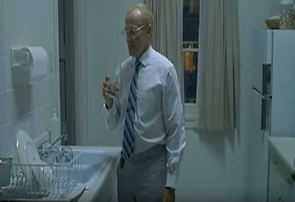

Acting –
This is very important in filming. It determines what kind of result the film will end up producing. The use of a star can have an influence on the audience expectation whether it is good or bad. Robin William’s being a big name title in himself helps the movie become bigger and helps others in wanting to watch this film.
Robin Williams’s performance was very outstanding;
His use in voice was very effective throughout the film.
Volume – loud and forceful when he needed to be feared, scene of when he was yelling at Mr. Yorkin’s and his mistress. His use of soft voice was gentle when he was taking to Jake.
Tone – Robin Williams was able to give off a disturbing, chilling and self-possessed tone at times throughout his performance.
Facial expressions – aggravated expression, wide eyes, evil eyes, gentle smiles and calmness, anger and fear
Gestures/ Body language/ mannerisms – tense, anxious, fidgeted, rigid, still
Style of acting:
Naturistic – this acting is far more subtle and realistic and being the way the film is, I feel like this is more of the style chosen. This style appears natural and doesn’t draw attention to itself. This is often referred to as method acting where actors try to create in themselves the thoughts and emotions of their characters in an effort to develop lifelike performances.

Sound –
Diegetic sound and Non-diegetic sound – there was times where the characters were placed in a diegetic situation where they can hear the sound while they are on set. Non diegetic was when they couldn’t hear the sound and the sound was placed in the editing transitions.
Dialogue: the sounds produced in the dialogue was able to uncover a few things about what was to except. First few things we notice was that the set out was creepy and set in light fear that would grow later in the film.
Music: the music often used and chosen was thrilling and suspense filling. These selections was able to set in a sense of terror at times that made you question what is going to happen.
Sound effects: The sound effects used were in non-diegetic format, but this makes things more intense and you feel more fearful. Also was added to improve the realism and the impact of the scene/event.
Setting –
The time was set in the early 2000’s and was set in California, USA. Climate was around spring-autumn, slightly cold but getting warmer and wasn’t in the winter. The way we can tell this, is by looking at the colours of the trees and the fact the characters wore warm clothes throughout the movie. The director chose a suburban area where it was family friendly.
This information that is given by the director helps tell the story of Sy’s life and helps the audience piece together his surroundings too.


Characters –
The audience have to believe in the character’s performance. How they are able to present themselves is another part of being able to sell the film itself. If they can’t sell the characters performance then it is likely the movie might end up not as successful as the director hoped for.
Robin Williams as Sy for example:
He behaves in an odd manner that makes us think he’s somewhat normal until his character develops a little more and you start to find he is a bit strange. One of his opening sentences towards Mrs. Yorkin, sharing her address off by heart because he’d served them for over the 10 or so years as Jake, the Yorkins son, grew up. Sy happened to be there throughout all the family outings and events because he was just “Sy the photo guy” but to Sy they became his family, this was an unhealthy attachment to a family that didn’t suspect a thing. He appeared nice and friendly, but soon enough became a stalker who took a copy of his own from their photos. These photos we’d later see in an ordered state on a large wall. The reason he was introduced is because he is the main character, but the reason things took a turn for the worst was when he came across a customer and something in his mind clicked because he recognized the face. Once that clicked with him he became unstable and concerned for the Yorkins family wellbeing, leading him to terrible things. A lot of the characters help with being able to compliment Sy and help the story move and develop. Because without this one character that Sy recognized none of the story would’ve ended up the way it did.
Robin Williams was able to mold into the character and was able to give off the best thriller drama film he would’ve created.
